

FAQ Of Activated Carbon Filtration
Leave a message
In today's health-focused, tech-driven era, we are constantly navigating the challenges of modern living alongside the innovative solutions designed to address them. One such challenge is the quality of tap water, which often contains harmful chemicals-some even linked to cancer. Thankfully, carbon block filters provide an effective remedy.
Why Do People Use Carbon Block Filters?
In simple terms, tap water contains a mix of chemicals, particles, bacteria, organic matter, and toxins-some of which slip through regulatory gaps or meet outdated safety standards. Carbon block filters offer the most reliable protection against these contaminants. By installing one in your home, you can safeguard your water regardless of what happens in the external supply system.
The presence of these harmful substances stems from the difficulties water utilities face. Even when sourced from springs or reservoirs-sometimes naturally drinkable-water is typically treated and disinfected before distribution. However, as it travels through miles of aging pipes, it can accumulate bacteria and other pollutants along the way.
To combat this, utilities add disinfectants like chlorine. But this process introduces other unwanted chemicals, including volatile organic compounds (VOCs), bromates, fluoride, sulfates, nitrates, and even radioactive elements like radium. Some are disinfection byproducts; others come from agricultural runoff, industrial waste, or natural deposits in the earth. Whatever the source, most tap water contains at least some of these contaminants, making filtration essential.
The high efficiency of carbon block filters lies in the remarkable properties of activated carbon, which has proven to be one of the most effective and practical solutions for clean water.
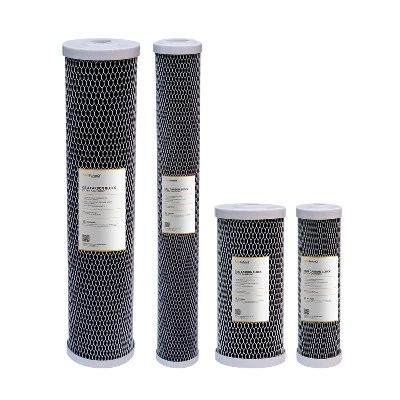
What Is Activated Carbon Filtration?
Activated carbon is a highly porous adsorption material-meaning it attracts and holds liquids across its vast surface area. Composed primarily of carbon, it has an intricate, disordered structure where atoms bond in random arrangements, creating countless microscopic pores throughout.
This labyrinth of tiny cavities provides extraordinary adsorption capacity: A single pound of activated carbon boasts a surface area equivalent to about 125 acres.
While activated carbon can be derived from various organic sources like olive pits or peat moss, water filtration demands specific properties. The ideal material must effectively adsorb contaminants, introduce no unpleasant taste or odor, and resist clogging.


