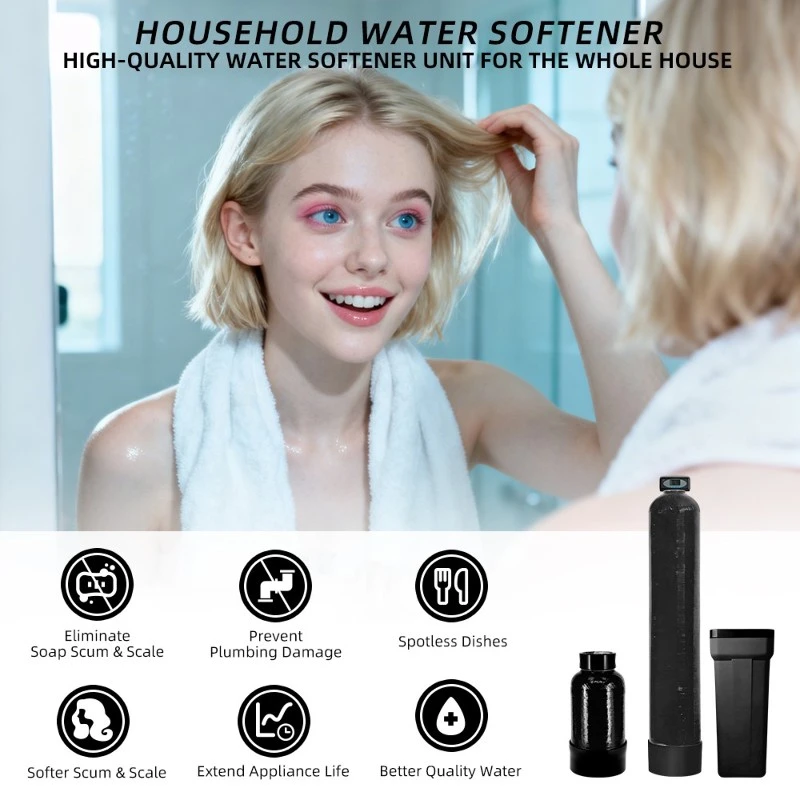
Water Softeners Frequently Asked Questions
Leave a message
1. How does a Water Softener Function?
Fundamentally, the resin inside the mineral tank is engineered to capture "hard" particles of lime and calcium through an ion exchange mechanism. The resin beads carry an electrical charge opposite to that of the dissolved minerals in the incoming water. This charge difference causes the minerals to adhere to the beads upon contact, effectively removing them and producing softened water. The resin has a finite capacity for holding these hardness particles, which explains why softeners come in various sizes and require periodic regeneration.
2. Does a Water Softener Make Water Safe for Drinking?
No. Water should be safe for consumption prior to softening. If you have concerns about your drinking water's safety, please contact your local health authority to request a bacterial test or comprehensive laboratory analysis.
3. Why Does Softened Water Feel Slippery During Showering?
Hard water minerals like calcium and magnesium interfere with soap's cleaning action by forming an insoluble film. Softeners replace these minerals with sodium, which doesn't react with soap. This allows soap to rinse away completely without residue, creating a smooth sensation that indicates effective cleaning rather than soap accumulation.
4. How Do I Determine the Correct System Type and Size for My Home?
System sizing depends on two primary factors: water composition (mineral type/concentration) and household water demand (based on occupancy). Flow rate requirements (typically ~5 GPM for homes) determine unit capacity, while mineral concentration dictates treatment media volume. Larger mineral tanks provide longer water-media contact time, ensuring complete contaminant removal before water exits the system.
5. Can a Water Softener Cause Pressure Loss, and How Can It Be Resolved?
Yes, a water softener will typically introduce a minor, expected pressure drop due to the natural resistance of water flowing through the resin bed. However, significant or excessive pressure loss usually indicates an underlying issue, which can stem from one or more of the following causes:
For Well Water Systems: The most frequent cause is the infiltration of fine sand or silt from the well, which can clog the lower parts of the softening system.
For Systems Exposed to Sunlight: In rare cases, such as in warm climates like Florida, exposure to sunlight can promote algae growth inside the tank. Pieces of this algae can break off and block the screen on the lower distributor tube.
For Chlorinated Municipal Water:
Sand or debris can occasionally enter the tank from new construction or repairs in the municipal water lines.
A more common cause is chlorine damage to the resin beads. High chlorine levels can cause the resin to break down into a mush-like consistency. This resin "mush" settles at the bottom and severely restricts water flow, mimicking the effect of fine sand.
The definitive solution for all these scenarios involves emptying the resin tank, thoroughly cleaning it, and replacing the old resin with new material. One cubic foot of resin is generally sufficient for a standard residential softener. We can provide a precise amount if you supply the exact internal dimensions of your resin tank.